
Granada's Albayzin - From Poverty To Riches
A short history of the Albayzin
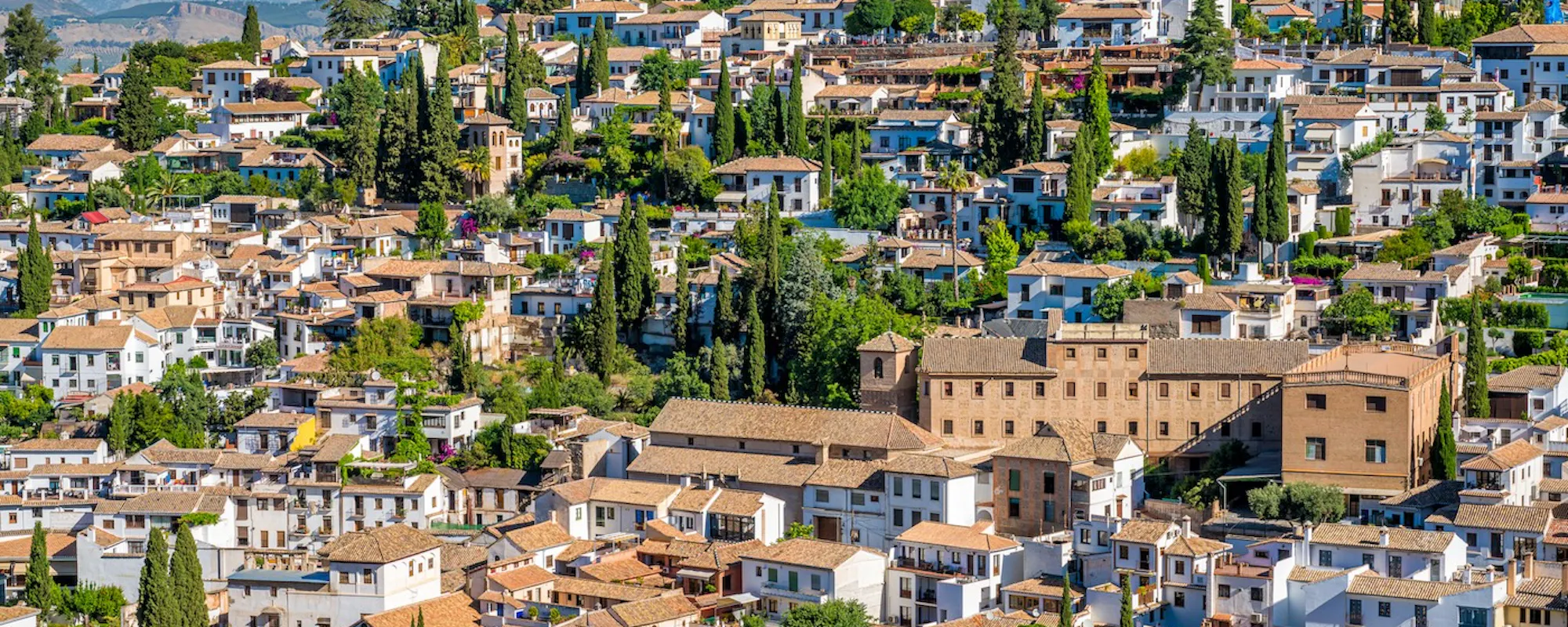
Few neighbourhoods in Europe contain quite as much history within such a small area as Granada's Albaicín. Today we think of its white houses and carmens, narrow cobbled streets, hidden gardens and extraordinary views across the valley of the Darro to the Alhambra. It has become one of the most desirable places to live in Granada and, according to recent figures, the most expensive neighbourhood in the city in which to rent a home.
Yet during the twentieth century the Albaicín was widely regarded as one of Granada's poorer neighbourhoods. Houses were abandoned, buildings deteriorated and families moved away in search of more modern homes with easier access, bathrooms, heating and cars parked outside the door. Go back further still and the story changes again.
The Albaicín is not simply Granada's old Moorish quarter. The hill on which it is located is where Granada itself began.
The Iberian Settlement
People lived on the Albaicín hill long before Islam reached the Iberian Peninsula in 711 AD.
Archaeological investigation has found material dating from at least the sixth and seventh centuries BC. The Iberian settlement generally identified with Ilturir or Iliberri developed here, taking advantage of an exceptionally defensible position above the River Darro and overlooking the fertile Vega.
The Albayzin hill provided natural protection, water was available, the surrounding plain was extraordinarily fertile and important routes through eastern Andalucía could be controlled from the settlement.
Roman occupation followed. The Roman town of Iliberris — Municipium Florentinum Iliberritanum — occupied this same general area, and archaeological excavations throughout the Albaicín continue to reveal Iberian and Roman remains beneath later Islamic and Christian buildings.
At the Placeta de San José, for example, archaeologists have recovered material extending from the sixth century BC to modern times, including structures belonging to an Iberian-Roman or Republican Roman settlement and coins minted by Iliberri itself.
This extraordinary layering explains one of the complications of restoring a house in the Albaicín today. Dig beneath a seventeenth-century building and you may encounter a Nasrid wall; beneath that, Zirid remains; and beneath those, something Roman or Iberian. The history of Granada is literally beneath the floorboards.
The Muslim city
The decisive transformation came after the Islamic conquest of the Iberian Peninsula in the eighth century, although the great urban expansion of the hill occurred considerably later.
By the beginning of the eleventh century the collapse of the Caliphate of Córdoba had fragmented Muslim Spain into competing taifa kingdoms. The Zirid dynasty established Granada as the capital of its kingdom and, from approximately 1013 onwards, developed the settlement on the Albaicín hill into a fortified city. This was the Granada of the Alcazaba Qadima — the Old Citadel.
Large sections of the massive Zirid wall still survive today, particularly around the upper Albaicín. Gates, walls, cisterns and fragments incorporated into later buildings provide clues to the city that existed here nearly a thousand years ago.
Granada's centre of political gravity was not initially in the Alhambra, but on the hill opposite. It was the Albaicín hill that contained the principal fortified settlement of Zirid Granada.
Water was fundamental to its expansion. The Acequia de Aynadamar, bringing water from the spring at Fuente Grande in Alfacar, supplied cisterns throughout the hill. Many of these aljibes survive. They are among the most important monuments of Islamic Granada: an urban water-distribution system that made dense settlement on this steep and relatively dry hill possible.
Origin Of The Name Albaicín
The name is a historical puzzle. The Arabic form was Rabaḍ al-Bayyāzīn — the rabad, or suburb, of the Bayyāzīn. For many years the most familiar explanation was that Bayyāzīn referred to people from the town of Baeza. When Fernando III of Castile conquered Baeza in 1227, Muslim refugees fled southwards and some are believed to have settled in Granada. According to this interpretation, the new quarter became the suburb of the people fleeing from Baeza.
There is, however, another interpretation increasingly favoured by scholars: that al-Bayyāzīn means the falconers, making it the district of the falconers. The existence of other neighbourhoods with similar names in Andalusi towns makes the Baeza explanation less credible.
There is another intriguing complication. Research at the University of Granada has established that the name al-Bayyāzīn does not appear in surviving Arabic written sources until the first decades of the fourteenth century. So while settlement here was vastly older, and the Zirid city already several centuries old, the name by which the neighbourhood is known today appears comparatively late in its history.
Even the spelling survives in two forms: Albaicín, now the standard Spanish spelling, and Albayzín, the historic form still widely used in Granada and retained in many names and businesses, including our own.
The Population Explosion
The thirteenth century changed Granada dramatically. As Christian armies advanced southwards, Muslim populations displaced from conquered territories migrated towards the remaining Islamic kingdom of Granada. The city's population expanded enormously.
Under the Nasrid dynasty, founded in 1238, political power shifted decisively across the River Darro to the Alhambra. But the Albaicín did not lose its importance. It developed into an immense, densely inhabited suburb — one of the richest, busiest and most populous parts of Nasrid Granada. This is an important to understand when looking at the Albaicín today.
The open gardens and large carmens that we now regard as characteristic of the neighbourhood give a misleading impression of the medieval city. The Nasrid Albaicín was densely populated. Houses crowded against one another along narrow streets. There were neighbourhood mosques, public baths, bakeries, workshops, markets and cemeteries. Water flowed into public cisterns. Craftsmen worked from houses and workshops. The neighbourhood had its own principal mosque and even enjoyed a degree of judicial autonomy.
During the reign of Yusuf I in the fourteenth century, a new defensive wall enclosed the much expanded suburb. Much of this great Nasrid wall still strides across the upper hillside towards San Miguel Alto. The Puerta de Fajalauza, still standing, was one of its principal entrances.
From the Alhambra, therefore, the view across the Darro would have been very different from today's mixture of tiled roofs, white walls, gardens and cypress trees. It would have been a densely packed Muslim city.
1492 The Reconquista
The surrender of Granada to the Catholic Monarchs in January 1492 brought the Nasrid kingdom to an end. Initially, the terms of surrender were remarkably generous. Granada's Muslim inhabitants were promised protection for their religion, property, style of dress, customs and institutions. The Albaicín remained overwhelmingly Muslim but that accommodation did not last.
Under Cardinal Cisneros, a christian zealot and destroyer of vast libraries of learning purely because they were written in Arabic and therefore, he assumed, religious in nature, pressure for conversion intensified. In December 1499 the Albaicín rose in revolt against the creeping removal of privilege guaranteed under the Santa Fe Accords of 1492. The rebellion was suppressed and the political settlement that had supposedly guaranteed Muslim religious life rapidly unravelled.
By 1501, Granada's Muslims faced conversion to Christianity or departure. Those who converted became the population subsequently known as Moriscos. The Albaicín became their great urban stronghold. Mosques were converted into churches and this explains one of the most characteristic features of the modern neighbourhood: Christian churches with square Mudejar (the name given to the art and architecture of Moslems who remained under Christian domination after the Reconquista) towers built over former mosques.
The Morisco House
The transitional period from Moslem to Christian produced some of the Albaicín's most fascinating architecture. The typical casa morisca retained many features of the Islamic house: an inward-looking plan, rooms arranged around a courtyard, galleries, timber work and a deliberate separation between the private interior and the public street. From the outside, such a house appears remarkably plain. Inside was another world.
That principle remains fundamental to understanding the Albaicín. Unlike a nineteenth-century European boulevard where wealth is displayed on the façade, the traditional house reveals little to the passer-by. The beauty is internal: courtyard, fountain, carved timber, garden, views and privacy.
Some surviving Morisco houses date from the fifteenth and sixteenth centuries. The Junta de Andalucía describes the Albaicín immediately before the Christian conquest as Granada's most populous, wealthy and industrious neighbourhood, but its decline had already begun.
Rebellion and Expulsion
Tension between the Morisco population and the Christian authorities culminated in the Revolt of the Alpujarras of 1568–1571.
After its suppression, the Moriscos of Granada were dispersed and their property confiscated. The Spanish Crown began a programme of repopulation with Christians from elsewhere, especially from the north of Spain. For the Albaicín, the consequences were profound. The population collapsed.
Houses were abandoned. Others were demolished to create larger dwellings. Paradoxically, one of the most beautiful characteristics of today's Albaicín emerged partly from economic and demographic collapse.
Birth of the Carmen
The word carmen in Granada describes a particularly Granadan form of property combining house, garden and productive land, traditionally enclosed behind walls. The term derives from the Arabic karm, associated with a vineyard or cultivated garden.
As neighbouring Morisco plots were abandoned, properties could be amalgamated. Houses acquired gardens, orchards and space. The dense medieval urban fabric loosened.
The Ayuntamiento de Granada identifies precisely this process — the aggregation of former Morisco properties following depopulation — as the origin of the Albaicín carmen, although the romantic appearance of the carmen familiar today developed principally during the nineteenth century.
These were not originally all luxurious pleasure gardens. Many were working properties containing vines, fruit trees, vegetables, chickens and sometimes other animals. They combined urban life with something surprisingly close to the countryside. Archaeological research describes a process of ruralisation. A neighbourhood once crowded with inhabitants began to acquire the lower-density appearance that we now think of as quintessentially Albaicín.
It is still possible to walk for ten minutes from Plaza Nueva and find yourself behind a high wall in a garden containing oranges, lemons, vines, pomegranates, cypresses and an alberca, apparently isolated from the city around it.
The Romantic Discovery
By the nineteenth century the Albaicín had become poor, picturesque and, to foreign eyes in particular, intensely romantic. The European fascination with Spain — and especially with Granada — transformed perceptions of the city.
Writers, painters and travellers came looking for the remains of Al-Andalus. Washington Irving's Tales of the Alhambra, published in 1832, helped turn Granada into one of Europe's great romantic destinations.
The Albaicín fitted the image perfectly. Its ruined walls, hidden gardens, narrow lanes and views across the valley towards the Alhambra, represented an exotic Spain that northern European visitors found irresistible.
What tourists saw as picturesque, however, local residents often experienced as poverty. That contradiction would persist for well over a century.
The Twentieth Century Albaicín
It is difficult from today's property prices to appreciate just how modest much of the Albaicín remained during the middle decades of the twentieth century. Many houses lacked modern sanitation. Access was difficult. Streets were steep and narrow. Cars could not reach large parts of the neighbourhood. Old buildings required constant maintenance and there was little money available to provide it.
For a working family in post-war Granada, a modern flat elsewhere in the city represented progress. It had a bathroom. It had reliable electricity and water. It might eventually have central heating. You could drive to it.
The Albaicín offered history, views and architectural character, but these were not necessarily the priorities of families emerging from the privations of the Civil War and the difficult decades that followed. Consequently, houses deteriorated and population moved away.
Some substantial properties were divided into inexpensive accommodation. Others were simply abandoned and fell to ruin. Gardens became overgrown. Historic buildings disappeared. Attempts were made between 1938 and 1951 to improve road access and modernise parts of the neighbourhood, but the fundamental problem remained: the Albaicín was increasingly perceived as inconvenient, inaccessible, old-fashioned and poor.
The Great Reversal
Then something remarkable happened. The very characteristics that had caused people to leave became the characteristics that made people want to return. The streets were too narrow for cars, and therefore wonderfully peaceful. The houses were old, and therefore historic. The neighbourhood was difficult to redevelop, and therefore escaped much of the demolition that transformed the centre of the city.
The gardens that were impractical to maintain became hugely desirable outside spaces. And the steep hill produced views that could not be replicated anywhere else in Granada. From the later twentieth century onwards, artists, architects, academics, foreigners and middle-class Granadinos increasingly rediscovered the Albaicín.
Old houses were restored. Carmens that had been neglected for decades became highly desirable residences. Foreign buyers discovered that it was possible to own a house with a substantial garden and an uninterrupted view of one of the world's great monuments while living within walking distance of the centre of a provincial capital. The economic logic of the neighbourhood had completely reversed.
UNESCO and Preservation
The decisive international recognition of the Albaicín’s importance came in 1994, when UNESCO extended the existing World Heritage designation of the Alhambra and Generalife to include the whole of the Albaicín. The Junta de Andalucia describes the approximately 110 hectare neighbourhood as an exceptional synthesis of Islamic vernacular architecture and later Andalusian building traditions.
World Heritage status brought prestige, conservation funding and much greater scrutiny of development. It also created a dilemma that remains unresolved: the Albaicín needs people to live in it.
Forgotten Barrio to Expensive Location
The financial transformation of the Albaicín has been extraordinary. for property purchase prices. The latest property purchase prices and rental figures produce an extraordinary historical footnote. The Albaicín has now been reported as the most expensive neighbourhood in Granada in which to buy or rent a home. The contrast with the neighbourhood of only two or three generations ago could hardly be greater.
The irony is striking. For centuries the threat to the Albaicín was abandonment because nobody wanted its old houses. Today one of the threats is that so many people want them.
Fascination With The Albaicín
Perhaps the reason the Albaicín remains so fascinating is that there is no single Albaicín.
Iberian settlement, Roman city, fortified Zirid capital, Nasrid rabad, crowded with houses, mosques, baths and workshops, Morisco neighbourhood desperately preserving a culture after the Christian conquest, depopulated seventeenth-century hillside in which demolished houses became gardens, nineteenth-century romantic Albaicín of travellers, painters and writers, poor twentieth-century barrio of modest houses, washing hanging across narrow streets and children playing in placetas and today UNESCO World Heritage neighbourhood, internationally famous and increasingly expensive.
All of them remain visible. And across the Darro stands the Alhambra. The relationship between the two hills is one of the things that makes Granada unique. The Alhambra was the palace city: monumental, royal, military and deliberately spectacular. The Albaicín was where people lived. More than seven centuries later, despite conquest, rebellion, expulsion, poverty, abandonment, restoration and tourism, it still is.